
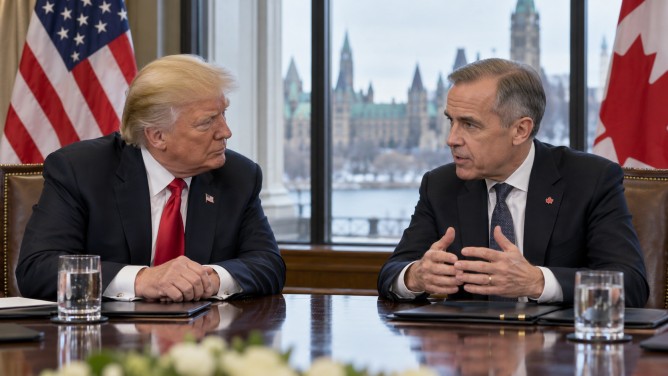
The United States and Canada are advancing towards a potential trade agreement amid ongoing negotiations between US President Donald Trump and Canadian Prime Minister Mark Carney. Both leaders have voiced optimism about the prospects of a deal that could alleviate the current economic tensions between the two neighboring countries.
During a speech in Iowa, President Trump revealed that he had recently engaged in discussions with Prime Minister Carney regarding bilateral trade relations. Trump described the proposed agreement as advantageous for American farmers and beneficial to the broader US economy. Additionally, he hinted at the inclusion of the Keystone XL pipeline project, a contentious energy initiative previously halted under former President Joe Biden, as a part of the trade talks.
Prime Minister Carney echoed the positive sentiment, acknowledging that his conversation with Trump had built upon prior constructive exchanges regarding a mutually advantageous trade framework. He indicated that officials from both nations would continue efforts in the coming weeks to push negotiations forward.
The trade relationship between Washington and Ottawa has been under strain since President Trump’s return to office, marked by the imposition of tariffs on several Canadian goods. The situation escalated in August when negotiations faltered, resulting in additional tariffs affecting approximately $20 billion worth of Canadian exports, including cement and hockey equipment. In response, Canada implemented retaliatory tariffs on American products, further escalating trade restrictions.
Despite some easing of US tariffs on Canadian goods, significant trade tensions linger, impacting businesses and economic interactions between the two countries. Concurrently, Canada has been actively diversifying its international trade partnerships, exemplified by a recent agreement with the European Union aimed at establishing a closer economic partnership and reducing reliance on the United States.
A successful US-Canada trade agreement could significantly reduce economic uncertainty, enhance cross-border trade, and improve relations between these two major trading partners, potentially paving the way for a more stable economic future.