
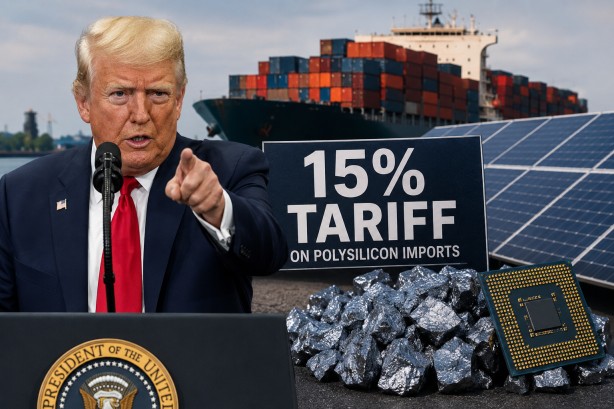
In a move aimed at bolstering domestic industry and reducing dependence on Chinese imports, US President Donald Trump has announced a 15% tariff on products made with polysilicon, a crucial material for semiconductor and solar panel production. This tariff is scheduled to be implemented on December 4 and targets the import of polysilicon, which is predominantly produced by China, the world’s leading supplier of this ultra-pure silicon variant.
Polysilicon plays a vital role in the manufacturing of semiconductors that are essential for running artificial intelligence systems and data centers, along with its use in solar cells and panels. To complement the tariff, the administration has also set minimum import prices: $21 per kilogram for polysilicon, $100 per kilogram for polysilicon ingots and wafers, $0.22 per watt for solar cells, and $0.38 per watt for solar modules and panels. These measures are part of a broader strategy to enhance the commercial viability of US polysilicon production and to secure critical supply chains that are integral to both economic and national security.
The United States currently hosts two significant polysilicon manufacturing plants, operated by Hemlock Semiconductor in Michigan and Wacker Chemie in Tennessee. The policy not only imposes tariffs but also opens up the possibility for the government to establish incentives for companies that choose to invest in the domestic production of polysilicon and its related manufacturing infrastructure.
China has expressed criticism of the US’s latest trade action, suggesting that national security concerns are being misused as a pretext to impose trade barriers against Chinese businesses. Beijing warns that such protectionist measures could potentially disrupt the flow of trade between the two economic giants. This tariff comes amidst a backdrop of robust growth in China’s export sectors, particularly in electronics, artificial intelligence products, and other high-value manufacturing industries.