
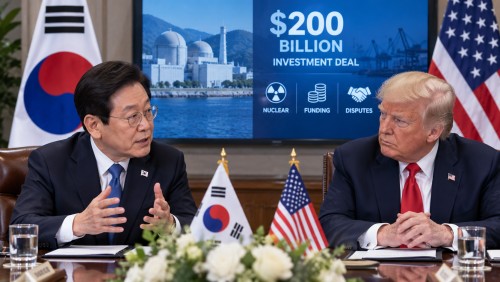
The ongoing negotiations between South Korea and the United States over a substantial $200 billion investment plan have encountered significant hurdles, particularly regarding nuclear power projects and related financial frameworks. The discussions aim to solidify South Korea’s investment commitments in the U.S., but differences persist, especially around nuclear reactor designs and the allocation of funds.
A central issue in these talks is the construction of eight nuclear reactors, where the technological approach has become contentious. The United States favors Westinghouse’s AP1000 design for six of these reactors, while South Korea has proposed its APR1400 technology for two. However, U.S. officials and Westinghouse have expressed concerns over integrating the Korean-designed APR1400, making it challenging to finalize this aspect of the deal. South Korea is also seeking a significant stake in Westinghouse, though the company wishes to limit Seoul’s ownership share.
The scope of the discussions extends beyond nuclear projects. South Korea is contemplating participation in a U.S. project for processing spent nuclear fuel and a proposed liquefied natural gas project in Alaska. These ventures, while promising, raise concerns about construction costs and potential financial returns, further complicating the investment landscape.
Timing and scheduling of financial contributions have also been points of contention. The U.S. has reportedly requested South Korea to contribute over $9 billion by the end of the year. In contrast, South Korea had planned a more gradual financial involvement, starting with smaller amounts in 2026 and increasing investments thereafter. This disparity in schedules adds another layer of complexity to their negotiations.
Profit sharing and loss calculations represent another sticking point. South Korea proposes that profits from successful projects should offset losses from others, whereas the U.S. prefers separate accounting for each project. Under the current framework being discussed, the U.S. would receive 90% of net profits post-recovery of principal and interest, a structure that South Korea fears might leave it absorbing losses from less successful investments.
Despite these challenges, both nations remain committed to reaching an agreement, with South Korea’s Industry Ministry emphasizing that final decisions on project selection, funding structures, and investment terms have not been made. The ongoing negotiations reflect the complexities of international investment and the strategic importance of cooperation between the two countries.