
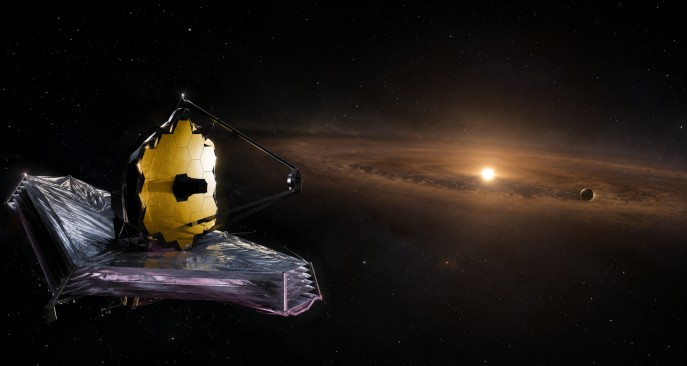
Astronomers have leveraged the advanced capabilities of NASA’s James Webb Space Telescope to uncover a new giant exoplanet, named Beta Pictoris d, in orbit around the star Beta Pictoris. This discovery expands the known planetary system of Beta Pictoris, bringing the total to three giant planets. The system, which is under extensive study, has long intrigued scientists with its dynamic features.
Beta Pictoris d stands out from its neighboring exoplanets due to the method of its discovery. Unlike the other two planets in the system, which were identified through direct imaging, this planet was revealed through the detection of its atmospheric chemical signatures. This breakthrough occurred when astronomers were employing the telescope’s Near-Infrared Spectrograph (NIRSpec) to examine another planet within the same system. This unexpected find highlights the potential of using atmospheric analysis in planetary detection.
Upon further investigation, researchers confirmed the existence of Beta Pictoris d by examining its atmospheric composition. They detected notable elements such as carbon monoxide, water vapor, and methane, affirming that it is indeed a massive planet. The planet resides within the system’s bright debris disk, a feature that had previously obscured its presence from conventional imaging techniques.
Sitting approximately 63 light-years from Earth, the Beta Pictoris system is about 23 million years old. It offers an invaluable opportunity for scientists to study the processes of planetary formation and evolution. The newly identified Beta Pictoris d is estimated to have a mass at least twice that of Jupiter and orbits its star at a distance similar to Neptune’s orbit in our solar system.
This discovery marks a significant achievement as it is the first instance of an exoplanet being identified primarily through moderate-resolution spectroscopy. This innovative approach not only unveils planets hidden within dense, dusty environments but also paves the way for more efficient searches for exoplanets throughout the Milky Way in the future.